Recipe Scaler
Paste your ingredients one per line, choose a multiplier or a serving count, and the list rewrites itself with friendly amounts. It reads fractions such as 1 1/2 or ¾, moves between spoons and cups where that reads better, and leaves lines without numbers untouched.
× 2
Handy gear on Amazon
SponsoredAs an Amazon Associate, MunchCooking earns from qualifying purchases. See our affiliate disclosure.
HONGBAKE 22-Piece Baking Pans Set Nonstick, Stackable Non Toxic Bakeware Sets with Diamond Texture, Oven Pan Set for Cooking, Includes Cookie Sheet with Rack, Cake Pan, Roasting Pan, Muffin Tin, Gold
$59.99$50.98
View on Amazon (HONGBAKE 22-Piece Baking Pans Set Nonstick, Stackable Non Toxic Bakeware Sets with Diamond Texture, Oven Pan Set for Cooking, Includes Cookie Sheet with Rack, Cake Pan, Roasting Pan, Muffin Tin, Gold)Mik-Nana Food Scale, 10kg/22lb Digital Kitchen Scale Weight Grams and Ounces for Baking Cooking Coffee Package Postage, 6 Units with Tare Function, LCD Display, Easy Clean Stainless Steel
$9.98
View on Amazon (Mik-Nana Food Scale, 10kg/22lb Digital Kitchen Scale Weight Grams and Ounces for Baking Cooking Coffee Package Postage, 6 Units with Tare Function, LCD Display, Easy Clean Stainless Steel)Thickened Heavy-Duty 26pcs Stainless Steel Bowl, Mixing Bowl Set with Lid, Grater Attachment, Non-Slip Bottom and Kitchen Gadget Set, Sizes 7, 4, 2.5, 2.0, 1.5, 1QT, Ideal for Mixing and Serving
$45.99$34.18
View on Amazon (Thickened Heavy-Duty 26pcs Stainless Steel Bowl, Mixing Bowl Set with Lid, Grater Attachment, Non-Slip Bottom and Kitchen Gadget Set, Sizes 7, 4, 2.5, 2.0, 1.5, 1QT, Ideal for Mixing and Serving)Amazon Basics Digital Kitchen Scale with LCD Display, Tare Function, Multiple Units, Weighs up to 11 Pounds, Batteries Included, Black and Stainless Steel
$11.14
View on Amazon (Amazon Basics Digital Kitchen Scale with LCD Display, Tare Function, Multiple Units, Weighs up to 11 Pounds, Batteries Included, Black and Stainless Steel)Cuisinart 3-Piece Stainless Steel Mixing Bowl Set with Lids, CTG-00-SMB | 1.5, 3 and 5 qt. bowls with matching lids, nesting storage, refrigerator, freezer and dishwasher safe
$39.99$23.99
View on Amazon (Cuisinart 3-Piece Stainless Steel Mixing Bowl Set with Lids, CTG-00-SMB | 1.5, 3 and 5 qt. bowls with matching lids, nesting storage, refrigerator, freezer and dishwasher safe)TILUCK Stainless Steel Measuring Cups & Spoons Set, Cups and Spoons | Stainless Steel Nesting Measure Cups , Kitchen Gadgets for Cooking & Baking (10)
$15.99$13.59
View on Amazon (TILUCK Stainless Steel Measuring Cups & Spoons Set, Cups and Spoons | Stainless Steel Nesting Measure Cups , Kitchen Gadgets for Cooking & Baking (10))Nicewell Food Scale 22lb Digital Kitchen Scale for Cooking Baking | Tare Function, Stainless Steel, Grams and OZ, 1g/0.1oz Precise Graduation, Backlit LCD, Easy Clean
$25.99$22.09
View on Amazon (Nicewell Food Scale 22lb Digital Kitchen Scale for Cooking Baking | Tare Function, Stainless Steel, Grams and OZ, 1g/0.1oz Precise Graduation, Backlit LCD, Easy Clean)Spring Chef Stainless Steel Measuring Cups and Spoons Set of 14 w/Leveler | Nesting Metal Measuring Cups for Kitchen & Rectangular Teaspoon & Tablespoon Measuring Spoons for Dry and Liquid Ingredients
$22.99$19.54
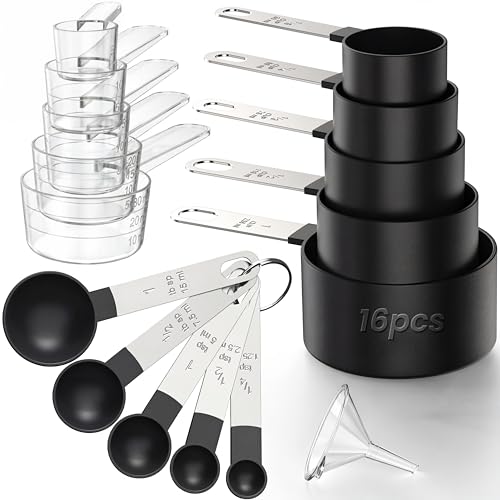
View on Amazon (Spring Chef Stainless Steel Measuring Cups and Spoons Set of 14 w/Leveler | Nesting Metal Measuring Cups for Kitchen & Rectangular Teaspoon & Tablespoon Measuring Spoons for Dry and Liquid Ingredients)KELOFKO 16 Pieces Measuring Cups and Magnetic Measuring Spoons Set Stainless Steel,8 Measure Cups with Silicone Handle and 7 Double Sided Magnetic Measure Spoons & 1 Leveler
$21.99
View on Amazon (KELOFKO 16 Pieces Measuring Cups and Magnetic Measuring Spoons Set Stainless Steel,8 Measure Cups with Silicone Handle and 7 Double Sided Magnetic Measure Spoons & 1 Leveler)


Prices and availability were accurate when retrieved from Amazon and may change. Retrieved Nov 20, 2026.
How the scaler reads your list
Paste or type
One ingredient per line, with the amount first: 1 1/2 cups flour, 2 tbsp sugar, 3 eggs.
Pick the factor
Use 0.5 to halve, 2 to double, or switch to servings and enter the old and new count.
Copy the result
Spoon and cup amounts are re-expressed (16 tbsp becomes 1 cup), and anything it cannot read is left as you wrote it.
Common amounts, scaled
| Amount | × ½ | × 1½ | × 2 | × 3 | × 4 |
|---|---|---|---|---|---|
| 1 cup | ½ cup | 1 ½ cups | 2 cups | 3 cups | 4 cups |
| 3/4 cup | ⅜ cup | 1 ⅛ cups | 1 ½ cups | 2 ¼ cups | 3 cups |
| 2/3 cup | ⅓ cup | 1 cup | 1 ⅓ cups | 2 cups | 2 ⅔ cups |
| 1/2 cup | ¼ cup | ¾ cup | 1 cup | 1 ½ cups | 2 cups |
| 1/3 cup | 2 tbsp 2 tsp | ½ cup | ⅔ cup | 1 cup | 1 ⅓ cups |
| 1/4 cup | 2 tbsp | ⅜ cup | ½ cup | ¾ cup | 1 cup |
| 1 tbsp | 1 ½ tsp | 1 tbsp 1 ½ tsp | 2 tbsp | 3 tbsp | ¼ cup |
| 1 tsp | ½ tsp | 1 ½ tsp | 2 tsp | 1 tbsp | 1 tbsp 1 tsp |
What does not scale in a straight line
Eggs. Half of three eggs is 1½, which you cannot crack. Round to the nearest whole egg, or whisk one egg and weigh out the share you need: a large egg is about 50 g (King Arthur chart).
Time and heat. A doubled batch in the same pan is deeper and bakes longer; a halved batch in a big pan browns faster. Keep the oven temperature, check early, and judge by the doneness cues in the original recipe. Changing the pan changes the answer too, so compare pan sizes before you scale: the baking pan size converter gives the factor from the pan areas.
Seasoning and leaveners. The converter scales every number the same way. For salt, spices and raising agents, taste and recipe notes are a better guide at large factors.
Frequently asked questions
How do I halve a recipe?
Set the multiplier to 0.5. Every amount is halved, 1 tablespoon becomes 1½ teaspoons, and ¼ cup becomes 2 tablespoons.
How do I halve one egg?
Whisk the egg and weigh it: a large egg is about 50 g, so use about 25 g. Measure by weight rather than by spoon.
Do baking times change when I double a recipe?
Often, yes, but not by a fixed ratio. A deeper batter takes longer; two pans side by side usually do not. Start checking at the original time.
Can I scale by servings instead of a multiplier?
Yes. Choose servings, enter what the recipe serves and what you want. The multiplier is the second divided by the first.
Sources: NIST SP 811 Appendix B.8 (US customary volumes); King Arthur Baking ingredient weight chart. Checked 2026-11-20.
Some links on this page are Amazon.com affiliate links; see our affiliate disclosure. Converted figures are for cooking and baking, not for medical or food-safety decisions.