Baking Pan Size Converter
Pick the pan the recipe calls for and the pan you own. The converter compares their areas to give a scale factor for the recipe, shows how much batter each pan holds, and draws both outlines at the same scale so the difference is easy to see.
Handy gear on Amazon
SponsoredAs an Amazon Associate, MunchCooking earns from qualifying purchases. See our affiliate disclosure.
GoodCook MegaGrip Baking Pan with Silicone Grip Handles Square Non-Stick Heavy-Gauge Steel Cake Pan Baking Dish for Brownies Bread Cake Baked Goods & More, Dishwasher Safe, 8x8-Inch,
$10.09$8.57
View on Amazon (GoodCook MegaGrip Baking Pan with Silicone Grip Handles Square Non-Stick Heavy-Gauge Steel Cake Pan Baking Dish for Brownies Bread Cake Baked Goods & More, Dishwasher Safe, 8x8-Inch,)DOWAN Casserole Dish, 9x13 Ceramic Baking Dish, Large Lasagna Pan Deep for Oven, 4.2 Quarts Baking Pan with Handles, Oven Safe and Durable Bakeware for Lasagna, Home Decor, Wedding Gift, Soft White
$35.99$26.99
View on Amazon (DOWAN Casserole Dish, 9x13 Ceramic Baking Dish, Large Lasagna Pan Deep for Oven, 4.2 Quarts Baking Pan with Handles, Oven Safe and Durable Bakeware for Lasagna, Home Decor, Wedding Gift, Soft White)RFAQK 100PCs Springform Cake Pan Set for Baking with Cake Decorating Kit | 3 Non-Stick Leak-Proof Springform Pans (4, 7 & 9 in) with Parchment Paper, Cake Leveler, Piping Tips & Beginner EBook
$24.94$21.20
View on Amazon (RFAQK 100PCs Springform Cake Pan Set for Baking with Cake Decorating Kit | 3 Non-Stick Leak-Proof Springform Pans (4, 7 & 9 in) with Parchment Paper, Cake Leveler, Piping Tips & Beginner EBook)Farberware Nonstick Bakeware 9-Inch x 13-Inch Rectangular Cake Pan, Gray | Bake brownies and casseroles, 13x9 baking pan for even heating, non stick baking pans, dishwasher safe, 450F safe
$15.99$11.40
View on Amazon (Farberware Nonstick Bakeware 9-Inch x 13-Inch Rectangular Cake Pan, Gray | Bake brownies and casseroles, 13x9 baking pan for even heating, non stick baking pans, dishwasher safe, 450F safe)Riccle 148PCs Cake Pan Set for Baking, 3 Non-Stick Springform Pan Set (4, 7, 9 Inches), Cake Decorating Kit, Piping Bags and Tips Set, Cake Leveler, Multi-functional Leak-Proof CheeseCake Pan (148)
$16.99$13.59
View on Amazon (Riccle 148PCs Cake Pan Set for Baking, 3 Non-Stick Springform Pan Set (4, 7, 9 Inches), Cake Decorating Kit, Piping Bags and Tips Set, Cake Leveler, Multi-functional Leak-Proof CheeseCake Pan (148))USA Pan Bakeware Nonstick Rectangular Cake Pan, 9 x 13-inch | Cake pans, rectangular cake pans, 9 x 13-inch size, nonstick bakeware, baking pan for cakes, cake baking
$28.99$19.99
View on Amazon (USA Pan Bakeware Nonstick Rectangular Cake Pan, 9 x 13-inch | Cake pans, rectangular cake pans, 9 x 13-inch size, nonstick bakeware, baking pan for cakes, cake baking)Chicago Metallic Professional Nonstick Round Cake Pan Set - 6 Inch | 3-Piece Bakeware Set with 6 Inch, 8 Inch, and 10 Inch Pans, Heavy-Weight Aluminized Steel for Even Baking
$18.10$14.99
View on Amazon (Chicago Metallic Professional Nonstick Round Cake Pan Set - 6 Inch | 3-Piece Bakeware Set with 6 Inch, 8 Inch, and 10 Inch Pans, Heavy-Weight Aluminized Steel for Even Baking)Gymdin 139PCS Springform Cake Pan Set - 4 Non-stick Cheesecake Pans(4/7/9/10-Inch) + Cake Decorating Supplies: Parchment Paper, Pastry Bags and Tips, Icing Scrapers, Cake Cutting Set & More
$32.99$16.35
View on Amazon (Gymdin 139PCS Springform Cake Pan Set - 4 Non-stick Cheesecake Pans(4/7/9/10-Inch) + Cake Decorating Supplies: Parchment Paper, Pastry Bags and Tips, Icing Scrapers, Cake Cutting Set & More)


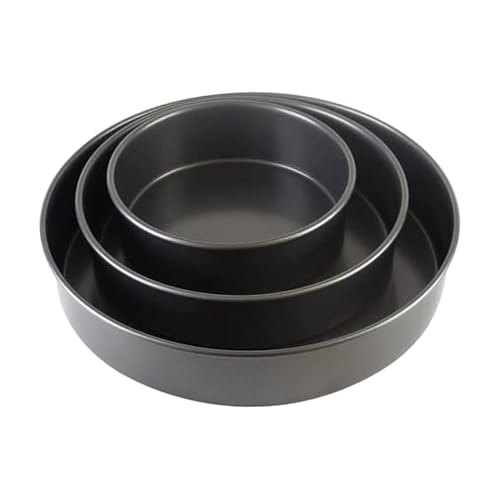

Prices and availability were accurate when retrieved from Amazon and may change. Retrieved Nov 20, 2026.
Why area, not diameter
A pan has three dimensions, and a recipe's batter fills a volume. For pans of the same depth the volume follows the area, so the area ratio is the scale factor. King Arthur gives the standard example: an 8 in round holds 26.6% less than a 9 in round, even though the diameters differ by only an inch. The same article puts the 9 × 5 in loaf pan almost 20% above the 8½ × 4½ in size. Both figures match the area ratios computed here.
When the factor is close to 1, swap the pans and keep the recipe. Above about 1.2 or below about 0.85, scale the ingredients, and treat the baking time as a guess to check early: a shallower layer in a bigger pan cooks sooner, and a deeper layer in a smaller pan takes longer. Match the oven temperature to the original recipe unless it says otherwise.
Pan areas and batter volumes
| Pan | Depth | Area (sq in) | Brim capacity (cups) | Batter at ⅔ full (cups) |
|---|---|---|---|---|
| 6 in round | 2 in | 28.27 | 3.92 | 2.61 |
| 8 in round | 2 in | 50.27 | 6.96 | 4.64 |
| 9 in round | 2 in | 63.62 | 8.81 | 5.88 |
| 10 in round | 2 in | 78.54 | 10.88 | 7.25 |
| 8 in square | 2 in | 64 | 8.87 | 5.91 |
| 9 in square | 2 in | 81 | 11.22 | 7.48 |
| 11 × 7 in rectangle | 2 in | 77 | 10.67 | 7.11 |
| 13 × 9 in rectangle | 2 in | 117 | 16.21 | 10.81 |
| 8½ × 4½ in loaf | 2.75 in | 38.25 | 7.29 | 4.86 |
| 9 × 5 in loaf | 2.75 in | 45 | 8.57 | 5.71 |
The ⅔ column follows Wilton's guidance to fill cake pans one half to two thirds full. Cakes that rise a lot, such as sponge or chiffon, want the lower end. Pans with sloped sides or rims hold a little less than the table; fill a pan with water to measure yours.
Frequently asked questions
Can I bake a 9 inch round cake in an 8 inch square pan?
Yes. King Arthur says an 8 in square and a 9 in round pan, both 2 in deep, hold about the same volume (around 8.8 cups). Check the cake a little early because the corners bake faster.
Can I use an 8 inch pan for a recipe that calls for a 9 inch pan?
Only with less batter. The 8 in round holds 26.6% less than the 9 in round, so scale the recipe to about 0.79 or bake the extra as cupcakes.
How full should I fill a cake pan?
Wilton advises one half to two thirds full. The table shows the two-thirds amount for each pan.
What if my pan is deeper or shallower than the table?
The area-based factor assumes the same depth. A deeper pan holds more, so you can fill it with more batter but it will bake longer; check early either way.
Sources: King Arthur Baking, why pan size matters; Wilton wedding cake guide (fill level). Checked 2026-11-20.
Some links on this page are Amazon.com affiliate links; see our affiliate disclosure. Converted figures are for cooking and baking, not for medical or food-safety decisions.