Toaster Oven vs Air Fryer: The Basic Difference
The phrase toaster oven vs air fryer comes up because these appliances overlap, but they are not the same tool. A toaster oven is best understood as a compact countertop oven. It typically uses radiant heat and can handle a wide range of jobs, from toast and reheating to baking, broiling, and some roasting. An air fryer is built to move hot air quickly around food, which is why it is often chosen for crisping and fast browning.
For families, that difference matters. A toaster oven often works like a small, flexible backup oven. An air fryer usually feels more specialized, with a clear focus on quick, crispy results for snacks, sides, and smaller portions. Both can earn a place in the kitchen, but they solve different problems.
If you are deciding between them, the most useful question is not which one is more popular. It is what you cook most often. If you want a compact appliance that can toast bread, reheat leftovers, and bake small dishes, a toaster oven may be the better fit. If you want something that can brown frozen foods, vegetables, and smaller meals with less effort, an air fryer may make more sense.
What a Toaster Oven Does Well
A toaster oven stands out because it can cover several everyday tasks in one countertop appliance. For many households, it becomes the easy answer for morning toast, open-faced sandwiches, reheated pizza, melted cheese dishes, and small baking jobs. It can also be helpful when you do not want to heat the entire kitchen for a few servings.
Its biggest advantage is flexibility. Depending on the model, a toaster oven may include toast, bake, broil, warm, and sometimes convection settings. That range makes it appealing if you want one appliance to handle many ordinary jobs. For family cooking, it can be useful for side dishes, baked snacks, or a tray of vegetables while the main meal finishes elsewhere.
A toaster oven also tends to feel familiar. Because it behaves more like a miniature conventional oven, the learning curve is usually modest. If you already understand baking or broiling, the appliance is easy to fit into your routine. That makes it a practical option for households that value versatility and control.
Its shape can matter too. A toaster oven often fits wider dishes, slices of bread, and small pans more naturally than an air fryer basket. If you prefer to use your own cookware or want a compact second oven-like space, that can be a real advantage.
What an Air Fryer Does Well
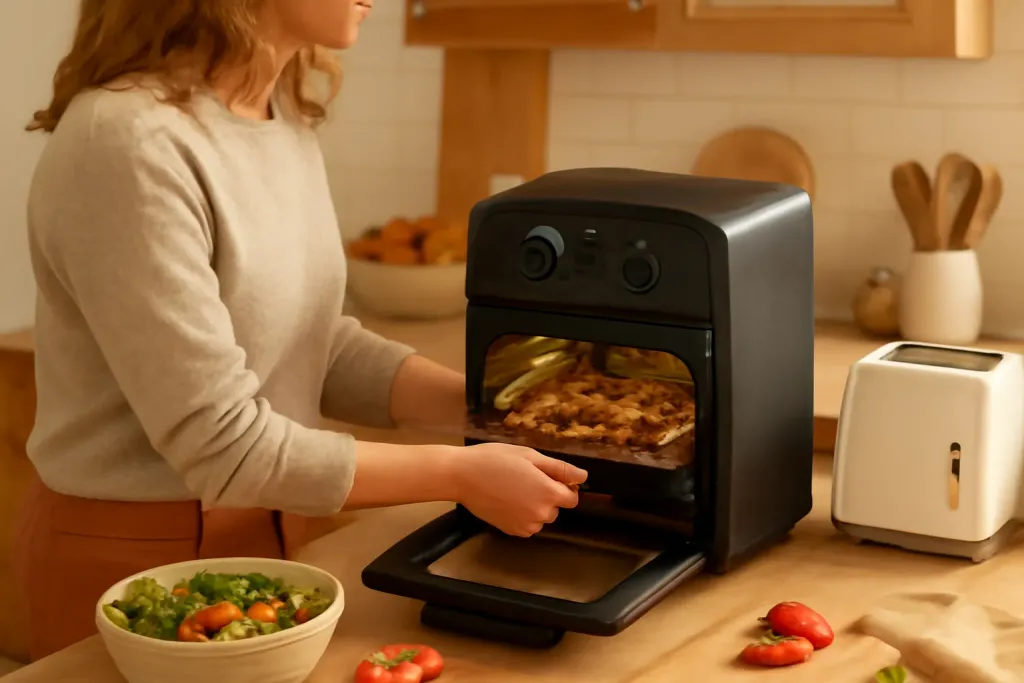
An air fryer is designed around airflow. Instead of relying mainly on still heat, it circulates hot air around the food to encourage browning and a crisper surface. That is why air fryers are often associated with frozen snacks, fries, breaded foods, vegetables, and quick portions of proteins. For busy families, the appeal usually comes down to speed and texture.
Many shoppers choose an air fryer because they want a fast way to finish foods with a crisp edge. It can be especially helpful on weeknights when you want a side dish or part of a meal to move quickly from freezer or fridge to table. In that sense, it functions like a convenience appliance with a very specific strength.
Capacity still matters. Some air fryers are compact and better suited to one or two people, while larger models can support family-sized batches more comfortably. Even then, basket-style cooking often works best when food is arranged with room around it. That means an air fryer can be very useful for family meals, but it may still call for batch cooking.
Air fryers are also easy for many people to understand. If your goal is to crisp, reheat, or cook smaller portions without much setup, the straightforward controls are appealing. For households that want a fast, repeatable routine, that simplicity is part of the draw.
Where the Two Appliances Overlap
The overlap in the toaster oven vs air fryer conversation is real. Both appliances can reheat leftovers, handle smaller portions, and reduce the need to turn on a full-size oven. Some toaster ovens also include convection features that move hot air more actively, which can bring them closer to air fryer-style results. Some air fryers also include bake, roast, or reheat functions that make them more versatile than people first expect.
This overlap is exactly why shoppers often pause before buying. If both appliances can crisp, reheat, and multitask, it is natural to wonder whether you need both. The answer depends on how you cook, how much space you have, and whether you want one appliance to do many jobs or two appliances that each do a different kind of work well.
In practical terms, overlap does not mean redundancy. It means the two devices can sometimes substitute for each other, but not always comfortably. A toaster oven can crisp, but it may not match the focused airflow of an air fryer. An air fryer can bake or toast in limited ways, but it is usually less convenient for wider pans or tray-based cooking. The details matter more than the label on the box.
Browse our recommended picks
Our featured picks refresh periodically. While we update them, our editorial guides can help you find the right one.
See our guidesDo You Need Both?
Not everyone needs both. Many households can do well with just one appliance if their cooking habits are clear. If you mostly toast, bake small dishes, broil, and want an oven-like helper for mixed tasks, a toaster oven alone may be enough. If you mostly want quick crisping, reheating, and small-batch cooking with minimal fuss, an air fryer alone may be enough.
That said, some kitchens benefit from owning both. The strongest case is workflow. A toaster oven can handle more traditional oven-style tasks, while an air fryer can focus on fast, crispy cooking. Together, they create a flexible setup: one for broader cooking and one for quick finishing. For family meals, that separation can reduce bottlenecks when you are juggling main dishes, sides, and snacks at the same time.
There is also a routine factor. Some households use a toaster oven year-round for toast, reheating, and small baking, then bring out the air fryer for vegetables, quick dinners, or frozen foods. Others rely on the air fryer most often and use the toaster oven as the more varied backup. If you can identify your own routine, the need for both becomes much clearer.
As a rule, you do not need both just because both are popular. You need both only if each would truly add something useful to your kitchen. If one would mainly duplicate the other, a single well-chosen appliance is usually the smarter use of space and money.
What to Consider Before Buying
Before choosing between a toaster oven vs air fryer, start with counter space. Countertop appliances only help if you can use them comfortably. A larger toaster oven may take more room, while a basket-style air fryer has a different shape that is not always easier to fit. Measure the space you actually have, including clearance above and behind the unit.
Next, think about capacity in real life, not just in theory. A family of four may want an appliance that can handle enough food for a meal, not just a snack. Wide trays, small pans, toast, and open dishes point toward a toaster oven. Single-layer crisping of fries, vegetables, nuggets, and similar foods points more toward an air fryer.
Cleanup is worth considering too. Some people prefer removable trays and pans that feel familiar from baking. Others like baskets or inserts that make crisping-focused cooking more direct. There is no universal winner here; the right choice depends on how much effort you want after dinner and which format fits your routine.
Daily habits often decide the question. If your family eats a lot of leftovers, either appliance may help. If breakfast toast is a daily ritual, a toaster oven has a strong case. If you regularly want quick crispy results after work, an air fryer may feel more essential. The best choice is usually the one that matches your routine instead of your wish list.
Best Choice by Household Type
For small households or couples, an air fryer may be the better pick if quick meals and crispy textures matter most. A smaller kitchen can also benefit from the focused cooking style and simple purpose of the appliance. On the other hand, a toaster oven may be the better fit if you want one device for breakfast, reheating, and occasional baking without relying on a larger oven.
For families, a toaster oven often feels like the more flexible everyday tool, especially if you want to toast, bake, and broil in one appliance. Still, families that make a lot of crispy sides, frozen foods, or fast after-school snacks may get more day-to-day value from an air fryer. In some homes, the right answer is not either/or but both, especially when one person is handling the main dish and another needs a quick side or snack appliance.
For apartment kitchens or other tight setups, simplicity matters. A single appliance that fits your most common tasks is usually better than two devices that compete for storage and counter space. In that situation, the choice should follow your most frequent cooking style. If you are mostly reheating and toasting, lean toaster oven. If you are mostly crisping and quick-cooking small batches, lean air fryer.
Ultimately, the best appliance is the one that reduces friction. When your countertop tool makes everyday cooking easier, it earns its keep fast. When it adds clutter or duplicates another device, it can start to feel unnecessary.
Bottom Line
The toaster oven vs air fryer decision comes down to how you cook, not which appliance is universally superior. A toaster oven is the more versatile, oven-like option for toast, reheating, baking, and broiling. An air fryer is the more focused option for fast, crisp results on smaller batches. Both can be valuable in a family kitchen, but they serve different priorities.
If you only want one, choose the appliance that matches your most common meals and snacks. If you want more flexibility and have the counter space, owning both can make sense because they complement each other rather than fully replace one another. For many households, the best answer is not to chase every trend. It is to choose the tool that fits the way you actually cook.