Overview
Air fryers are genuinely useful for busy family kitchens, but the biggest factor in whether one actually saves time is capacity. A model sized for one or two people forces a family of four into two or three cooking batches for a single meal, which can erase most of the time savings an air fryer is supposed to offer.
This guide focuses specifically on sizing an air fryer for a household of about four people, covering capacity ranges, how basket size affects cooking time, and the counter-space trade-offs that come with a larger appliance. We haven't run side-by-side timed tests across every model on the market; this is a sizing and decision framework based on how capacity and batch size generally interact, not a ranked list of specific tested products.
Capacity basics
Air fryer capacity is usually listed in quarts, and the right range depends on how much food you typically cook per meal, not strictly on headcount. As a general starting point, many family-of-four households find that something in the 6- to 10-quart range reduces the need for multiple batches on a normal weeknight, though your actual needs depend on portion sizes and how many sides you cook at once.
Smaller 2- to 4-quart models work well for a single serving or a side dish, but they typically require food to be cooked in overlapping layers, which reduces crisping and evenness -- most air fryers rely on hot air circulating around food, so overcrowding the basket works against the appliance's main advantage.
It's worth checking the manufacturer's guidance on maximum recommended food volume rather than relying on the total quart rating alone, since usable capacity is often somewhat less than the container's full volume once you account for proper air circulation.
How size affects cook time
A larger basket doesn't necessarily cook food faster per batch -- cook time is driven more by food thickness and target temperature than by basket size. What a larger basket changes is the number of batches required for a given amount of food, which is where most of the real time savings for a family comes from.
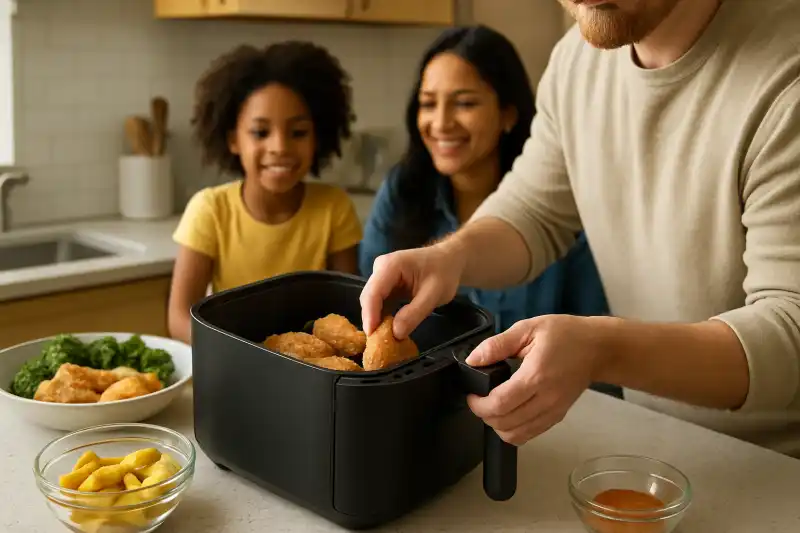
For example, cooking chicken tenders for four people in a small 3-quart basket might require two separate batches at roughly 12-15 minutes each, plus reheating time for the first batch while the second finishes. A larger basket sized to fit the full amount in one layer can cut that down to a single cooking cycle, even though the per-batch time is similar.
Dual-zone or dual-basket models add another variable: some let you cook two different foods at two different settings simultaneously, which can be useful for a protein and a side but adds complexity and generally costs more than a comparable single-basket model of similar total capacity.
Counter space and storage
Larger-capacity air fryers take up meaningfully more counter space, and that trade-off is easy to underestimate when browsing online. Before buying, measure the exact footprint you have available, including clearance space above the appliance for venting -- most air fryers vent hot air out the top or back, and blocking that airflow can affect performance and, per the manufacturer's manual, may pose a safety concern.
If counter space is limited, consider whether the appliance will live on the counter full-time or get stored in a cabinet between uses. Larger units are heavier and bulkier to lift in and out of storage regularly, which is worth factoring in alongside raw capacity.
Some households solve the space trade-off by choosing a mid-capacity model and accepting an occasional second batch on nights with larger portions, rather than sizing for the largest possible family meal. This is a reasonable middle ground if counter space is genuinely tight.
It's also worth checking the appliance's weight and handle design before buying if it will move between a cabinet and the counter regularly. Larger, family-size units can be awkward for one person to lift with wet or greasy hands, and a model with sturdy side handles is generally easier to manage safely than one without.
Browse our recommended picks
Our featured picks refresh periodically. While we update them, our editorial guides can help you find the right one.
See our guidesSingle-basket vs dual-basket designs
A single large basket is simpler to use and clean, and it's usually the more space-efficient choice per quart of capacity. It works well for households that mostly cook one dish at a time, like a tray of vegetables or a batch of chicken.
Dual-basket or dual-zone models split the interior into two independently controlled sections. This can be useful for cooking a protein and a starch at different temperatures simultaneously, which suits some family meal patterns well. The trade-off is that each individual zone has less capacity than a single-basket model of the same total quart rating, so very large batches of one food still may need to span both zones or require an extra round.
Neither design is inherently better -- the right choice depends on whether your typical family meal is one dish cooked in volume, or two or three smaller dishes cooked simultaneously.
Planning meals around batches
Even with a well-sized air fryer, some family meals naturally involve more food than a single basket can hold in one even layer. Rather than assuming the appliance alone will solve every batch-size problem, it helps to plan menus with the appliance's realistic capacity in mind. A tray of roasted vegetables and a batch of chicken tenders, for instance, might reasonably split between the air fryer and a sheet pan in the oven, cooking in parallel rather than in sequence.
This kind of planning is especially useful on nights with more than one component -- a protein, a starch, and a vegetable, for example. Some households designate the air fryer for whichever component benefits most from its texture (crispy proteins or vegetables), while handling grains, sauces, or other sides through a different method at the same time. That approach tends to produce a faster overall meal than trying to force everything through one appliance in sequential batches.
It's also worth building a small mental list of go-to air fryer meals that reliably fit your specific basket in one layer, since repeated use makes the capacity limits second nature. Over a few weeks, most households settle into a handful of dependable combinations that fit their appliance well, which reduces the guesswork on a busy weeknight.
Mistakes to avoid
The most common mistake is buying based on quart capacity alone without checking the manufacturer's recommended maximum food volume, which is often lower than the headline number suggests once you account for proper air circulation.
A second mistake is not measuring counter and cabinet clearance before ordering. Family-size air fryers are considerably larger than single-serving models, and a unit that looked reasonably sized in photos can be surprisingly bulky in person.
Finally, avoid assuming a larger air fryer eliminates all multi-batch cooking. Even a large-capacity model has limits, and some family meals -- particularly ones with several different components -- will still benefit from planning around one main air-fried dish plus stovetop or oven sides.
Final thoughts
For most families of four, a mid-to-large capacity air fryer in roughly the 6- to 10-quart range strikes a reasonable balance between reducing multi-batch cooking and staying manageable on a typical kitchen counter. Measure your available space first, then decide between a single large basket and a dual-zone design based on how your household typically structures a meal.
See our small kitchen appliances hub for sizing guidance on other countertop appliances, and our slow cooker meal-prep guide if you're building out a full weeknight appliance lineup.