Overview
A slow cooker is one of the more natural appliances to build a meal-prep routine around, since it does most of its work unattended while you handle the rest of your day. This guide walks through a practical weekly workflow: sizing your slow cooker, a repeatable prep-and-portion routine, and the food-safety basics that matter most for slow-cooked food specifically.
This guide focuses on general technique and workflow rather than specific tested recipes -- we don't claim to have personally tested or timed specific recipes, so treat any example combinations below as general starting points to adapt, not verified formulas.
Why a slow cooker fits meal prep
Slow cooking is largely hands-off once ingredients are in the pot, which fits naturally around a workday or a busy morning -- start it before you leave and come home to a finished batch. This makes it especially well suited to meal prep, where the goal is producing a larger batch of food you'll portion out over several days rather than a single dinner-sized amount.
It also tends to work well for larger cuts of protein and batch-friendly dishes like soups, stews, and shredded meats, which store and reheat well across the following days -- exactly the kind of food a weekly meal-prep routine relies on.
Sizing your slow cooker
For meal prep specifically, sizing slightly larger than your household's single-meal needs makes sense, since the point is producing leftovers. A household of two to four people doing weekly meal prep often finds a 5- to 7-quart slow cooker gives enough batch capacity without being excessive, though needs vary by how many meals you're prepping for and how large your portions are.
A smaller 1.5- to 3-quart slow cooker is better suited to a single side dish or a smaller household not specifically meal-prepping in bulk. Measure your available counter and storage space before buying, since larger slow cookers take up meaningful room, and check our small kitchen appliances hub for broader appliance sizing guidance.
A repeatable weekly workflow
A simple, repeatable structure removes most of the weekly decision-making. One common pattern: choose one slow-cooker batch (a protein, a stew, or a soup) as the week's meal-prep base, prep the ingredients the night before or morning of, and let it cook during the day or overnight depending on the recipe and your schedule.
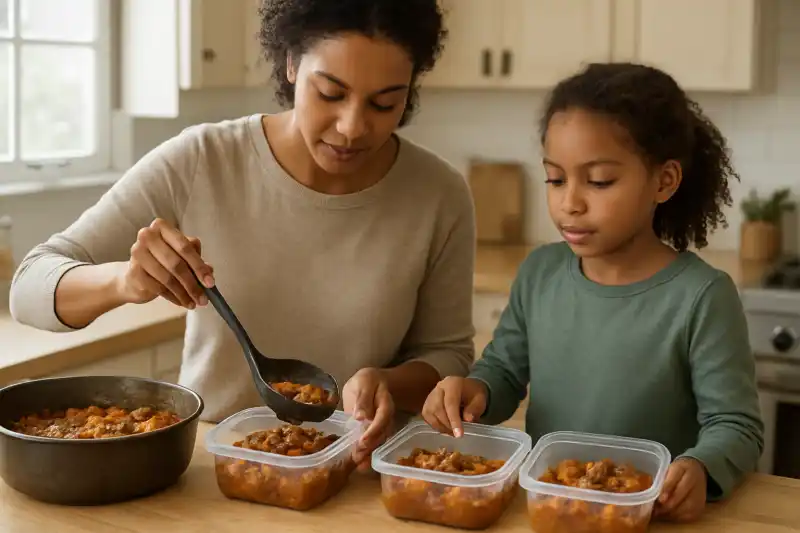
Once cooking finishes, portion the batch into your meal-prep containers as soon as it's safe to handle, rather than letting it sit in the slow cooker for an extended period. See our leakproof container guide for what to look for in containers that will hold up to being filled with warm, sometimes saucy, slow-cooked food.
From there, the same batch can be repurposed across a few different meals during the week -- a shredded protein, for example, can go into a grain bowl one night and a wrap or salad another, which keeps the routine from feeling repetitive despite starting from one base.
Pairing with other appliances
A slow cooker doesn't need to handle every part of a meal-prep batch on its own. Pairing it with a rice cooker or an instant-style pressure cooker for a grain component, or an oven for roasted vegetables, lets each appliance run in parallel rather than stacking every task onto one pot sequentially. This is particularly useful on a weekend prep day when you're trying to produce several days' worth of components in a single session.
Our air fryer sizing guide covers a similar appliance-pairing idea for faster-cooking components, like roasted vegetables that would otherwise compete for oven space. Building a small mental map of which appliance handles which type of food -- slow cooker for tougher proteins and stews, oven or air fryer for roasted vegetables, stovetop for anything quick -- tends to produce a faster overall prep session than relying on one appliance for everything.
It's worth noting that not every household needs multiple appliances to make this work. A single slow cooker batch, repurposed across a few different meals through the week as described above, is often enough on its own for a two- to three-person household. Appliance pairing becomes more valuable as household size or the variety of dietary needs within a family grows.
Browse our recommended picks
Our featured picks refresh periodically. While we update them, our editorial guides can help you find the right one.
See our guidesFood safety basics
Always follow the manufacturer's manual for your specific slow cooker, including recommended fill levels and cook settings -- overfilling can affect cooking time and food safety. Perishable ingredients should go into the slow cooker promptly rather than sitting at room temperature beforehand.
Once cooking finishes, food should be cooled and refrigerated within a reasonably prompt window rather than left at room temperature for an extended period; consult current USDA food-safety guidance for specific time and temperature recommendations, since these can be more precise than general advice like this can responsibly cover. Divide large batches into smaller, shallower containers before refrigerating, since this helps food cool more quickly and evenly than one large pot of hot food.
Reheat portions to a safe internal temperature before eating, and don't rely on the slow cooker's "warm" setting as a long-term food-safety hold for meal-prepped portions meant to last several days.
If you plan to freeze part of a batch rather than eating it all within a few days, portion it into freezer-safe containers while it's still relatively fresh rather than waiting until it's been refrigerated for several days first. Label containers with the date before freezing, since slow-cooked dishes can look similar to each other once frozen, and it's easy to lose track of how long something has been stored without a clear label.
What works well (and what doesn't)
Slow cookers generally excel at tougher cuts of meat that benefit from long, low cooking, along with soups, stews, chilis, and grain-based dishes that hold up well to reheating. These are also naturally batch-friendly, which lines up well with a weekly meal-prep goal.
They're less well suited to dishes that rely on a crisp texture, quick-cooking delicate proteins like fish, or anything meant to be served immediately at a specific texture, since slow cooking tends to soften textures over the extended cook time. For those, a different appliance or method is usually a better fit.
Dairy and delicate fresh herbs also generally do better added toward the end of the cook time rather than at the start, since hours of low heat can cause dairy to separate or curdle and can dull the flavor of fresh herbs. Starchy pasta is another ingredient that's easy to overcook in a slow cooker if added too early, since it continues absorbing liquid the whole time it's in the pot.
Mistakes to avoid
A common mistake is letting a finished batch sit in the slow cooker on the counter for hours before portioning it out, which works against the food-safety cooling window mentioned above. Portion and refrigerate promptly once cooking finishes.
Another mistake is treating every recipe as slow-cooker-friendly. Some ingredients (delicate vegetables, dairy added too early, quick-cooking proteins) don't hold up well to hours of low heat and are better added toward the end of cooking or prepared separately.
Final thoughts
A slow cooker fits naturally into a weekly meal-prep routine because its hands-off cooking style lines up with a busy schedule, and its batch-friendly output stores and reheats well across several days. Size it slightly larger than a single meal's needs, build a repeatable weekly structure, and follow food-safety cooling guidance once a batch finishes cooking.
See our meal-prep tools hub for container and batch-cooking equipment, and our small kitchen appliances hub for sizing guidance on other countertop appliances.