Why Knife Storage Matters
Learning how to store kitchen knives safely starts with a simple idea: sharp tools need a dedicated place. When knives are left loose in a drawer or propped carelessly on a counter, the blade can be exposed to fingers, other utensils, and accidental bumps. That creates unnecessary risk during everyday cooking, especially in busy family kitchens where more than one person may reach for the same tools.
Good storage does more than reduce the chance of cuts. It also helps protect the edge from rubbing against forks, spatulas, peelers, and heavy cookware. A knife that is repeatedly knocked around can lose its clean feel and become harder to use with confidence. Safe storage also makes the kitchen easier to navigate because each knife has a predictable place instead of getting buried under clutter.
For many households, knife storage is one of those small decisions that can improve both order and peace of mind. The best approach is not the most complicated one; it is the one that fits your kitchen, works for the people who use it, and keeps blades contained when they are not in use.
Common Storage Options at Home
There is no single answer for every kitchen, but several storage methods are widely used because they keep knives separated and easier to manage. The right choice depends on counter space, drawer space, and how often the knives are used.
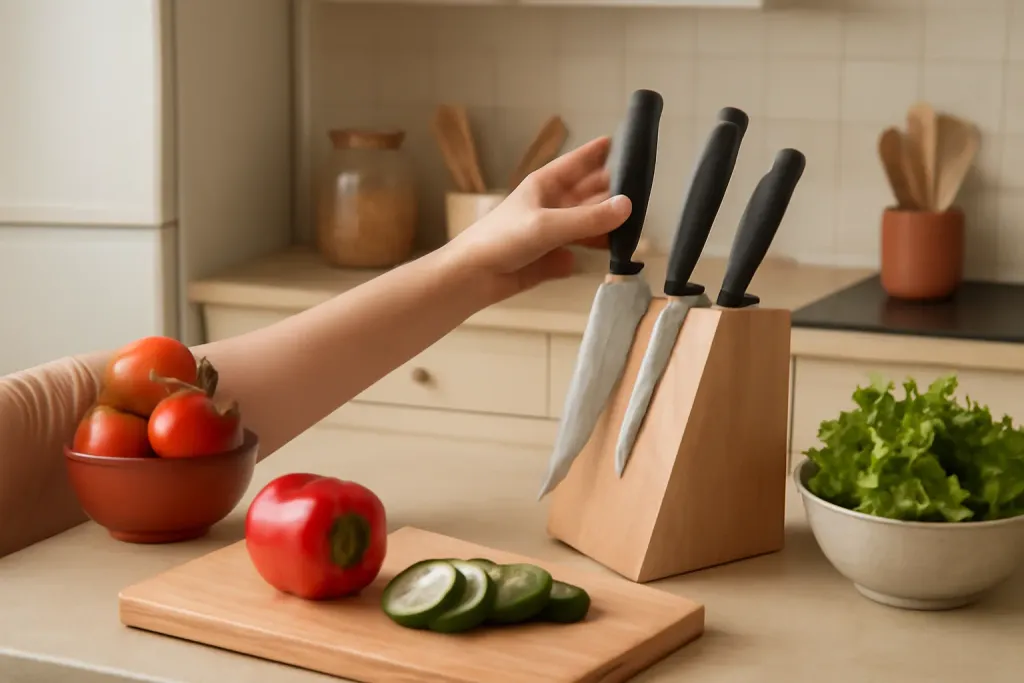
Knife blocks: These are familiar and convenient for cooks who want quick access on the counter. They keep blades upright and separated in slots, which can be practical if the block is placed in a stable area with enough room around it.
In-drawer organizers: These fit inside a drawer and hold knives in individual channels or compartments. They are useful when you want blades out of sight and away from casual reach.
Magnetic strips: Wall-mounted magnetic strips keep knives visible and easy to grab. They can free up drawer and counter space, but they need secure mounting and thoughtful placement.
Blade guards or sheaths: These cover the edge of an individual knife. They are especially helpful for drawer storage or for knives that do not fit neatly in a block.
Knife rolls or cases: These are often used when knives are moved or stored as a compact set. They can also help keep specialty knives separated at home.
Each option has tradeoffs, so it helps to think first about safety, then convenience. The best storage system is the one that will actually be used consistently.
How to Choose a Method That Fits Your Home
To decide how to store kitchen knives safely, start with the way your kitchen is used day to day. A storage method should fit the room and the routine. If counter space is tight, a drawer organizer or wall-mounted strip may be a better fit than a block. If drawers are crowded with utensils, keeping knives in a separate holder may prevent them from getting lost among other tools.
Household makeup matters too. In homes with children, storage that keeps blades enclosed or positioned out of easy reach is usually a stronger fit than loose storage. If several adults cook in the same kitchen, choose a system that is simple enough for everyone to return to the same way every time. Safe storage is easier when it is intuitive.
It also helps to consider the knives themselves. An everyday chef’s knife may fit well in a block or drawer tray, while a serrated knife or specialty blade may need a sheath or a different slot. Many homes use more than one method. For example, a block may hold the knives used most often, while a sheath protects an extra blade in a drawer.
Ask three practical questions before deciding: Where will the knives live? Who will reach for them? And how will the blades be kept from touching other items? A clear answer to those questions usually points to a storage setup that works.
Drawer Storage Tips
Drawer storage can be a strong choice when it is set up correctly. The key is separation. Knives should not be tossed into a drawer with forks, peelers, measuring tools, or heavy cookware. When blades move freely inside a crowded drawer, they can bang against other items, become harder to find, and create more risk when the drawer is opened.
A fitted knife tray or drawer insert helps keep each blade in its own place. If you do not have a tray, blade guards can add a layer of protection before a knife goes into the drawer. The goal is to keep the edge covered and the handle easy to grab without digging through clutter.
Try to reserve the knife drawer for knives and related items only. Overcrowding makes storage less practical and can turn an orderly setup into a jumble. If children are in the home, a higher drawer or a less accessible location may be a better choice. Some kitchens also use a simple latch for added control, though the main focus should still be on keeping blades contained and organized.
Drawer storage works best when returning the knife is easy. If putting it away feels awkward, people may stop using the system correctly. A straightforward layout is usually the most reliable one.
Browse our recommended picks
Our featured picks refresh periodically. While we update them, our editorial guides can help you find the right one.
See our guidesKnife Blocks and Magnetic Strips
Knife blocks and magnetic strips are two of the most recognizable ways to store knives on or near the counter. Both can work well when used thoughtfully, but each requires attention to placement and routine.
A knife block keeps blades separated in vertical slots, which helps reduce contact with other tools. It also makes it easy to pick up and return a knife during meal prep. One drawback is that blocks take up counter space, and the slots can collect dust or crumbs if they are not cleaned regularly. It is also important that the knife fits the slot without being forced in, since forcing can be awkward and unnecessary.
A magnetic strip saves space and keeps knives visible. That can be useful in smaller kitchens or in layouts where drawer space is limited. A strip should be mounted securely and placed where knives will not be bumped by cabinet doors, hands reaching past the wall, or heavy kitchen traffic. The strip should also be out of easy reach for children.
With either option, care matters every time the knife is removed or returned. Pulling too fast or placing the blade carelessly can create avoidable risk. These storage methods can be tidy and practical, but they work best when handled with patience.
Blade Guards and Transport Storage
Blade guards, sheaths, and knife rolls are helpful when a knife needs extra protection. They are especially useful for drawer storage, compact kitchens, or knives that are not used every day. A cover keeps the edge from touching other items and can make it easier to store a knife in a more flexible way.
Sheaths are often a good fit for single knives or blades with shapes that do not sit neatly in a block. They can be a simple way to protect a knife that gets used occasionally but still needs a safe place to rest. Knife rolls and cases are more common when knives are carried from one place to another, but they can also help keep a small collection separated at home.
Even with a cover, knives should still be placed in a stable spot. A guard protects the edge, but it does not make the knife immune to pressure or rough handling. Avoid dropping covered knives into an overloaded drawer or stacking heavy tools on top of them. A secure storage spot is still important.
For households that use several different storage methods, blade guards can serve as a useful backup. They help fill the gaps when a knife does not fit neatly into the main storage system.
Daily Habits That Help
Safe storage is about more than the storage product itself. Everyday habits make a big difference in how well the system works. A knife stored in a good place can still be unsafe if it is put away carelessly or mixed with other items that can damage the edge.
Dry knives before storing them so moisture does not sit on the blade or handle.
Return each knife to the same place every time instead of setting it down wherever there is space.
Keep knives away from loose metal utensils, heavy cookware, and tools that can bump against the edge.
Use both hands if needed when placing a knife into a block, tray, or sheath.
Make sure the storage area is stable and that the knife does not stick out in a way that could catch on a hand.
It helps to build knife storage into the cleanup routine. When storing the knife becomes the last step after washing and drying, the process feels more natural and is easier to repeat. If more than one person cooks in the home, a shared plan also helps. Everyone should know where the knives belong and how they should be returned after use.
When to Rethink Your Setup
Even a good storage system needs occasional attention. Over time, a knife block can collect dust, a drawer tray can shift, or a magnetic strip can loosen if it is not mounted well. A quick check every so often can help make sure the setup still fits the kitchen and still functions the way it should.
If the storage area starts to feel crowded, that is a sign to rethink the arrangement. You may have more knives than you need, or your current method may no longer match the way the kitchen is used. It can help to separate the knives you use most often from specialty blades and give each group a better home.
Watch for signs that a knife does not fit well. If a blade has to be forced into a slot, if a sheath slips off too easily, or if a drawer is packed too tightly, the system should change. Safe storage should protect both the person using the knife and the knife itself.
For many homes, the simplest approach works well: keep knives in one dedicated location, protect each blade from contact, and make it easy to return them after use. That is the practical core of storing kitchen knives with care at home.