Overview
A chef's knife is one of the few kitchen tools worth prioritizing early, and you don't need to spend a lot to get one that performs well for everyday home cooking. This guide consolidates the common searches for an affordable, budget, or cheap chef's knife into one selection framework, since the underlying question is the same regardless of the exact wording: what actually makes a lower-cost knife a good one?
We haven't physically tested a lineup of specific knives against each other. Instead, this guide explains the selection criteria that matter most -- blade length, material, handle fit, and balance -- so you can evaluate any specific listing against a consistent framework rather than relying on marketing copy or price alone.
What "affordable" actually means here
Prices for kitchen knives change constantly and vary widely by material, brand, and retailer, so we intentionally avoid citing a fixed price range in an evergreen guide like this one. Instead, think of "affordable" as a tier: a knife priced well below premium forged Japanese or German brands, but still made with genuine stainless steel and reasonable construction quality, rather than the very cheapest stamped blades sold in large multi-piece sets.
Within that affordable tier, quality varies more by construction details (full tang vs. partial tang, blade thickness, handle attachment) than by price alone, which is why the selection criteria below matter more than chasing the lowest number.
Blade length and shape
An 8-inch blade is the most versatile length for most home cooks -- long enough to efficiently chop larger vegetables and proteins, short enough to control comfortably. Smaller hands or smaller cutting boards might do better with a 6- to 7-inch blade, while some cooks prefer a 9- to 10-inch blade for extra reach on bigger prep jobs.
Chef's knives typically have a curved edge that supports a rocking chopping motion, as opposed to a straight-edged santoku or utility knife, which favors more of an up-and-down chopping motion. Either style works well; the choice comes down to which motion feels more natural to you.
Material basics
Most affordable chef's knives use stainless steel blades, which resist rust and staining better than high-carbon steel and require less maintenance -- a practical advantage for a budget-focused, low-maintenance kitchen tool. High-carbon steel can take a sharper edge and holds it longer in some cases, but it requires more diligent drying and occasional oiling to prevent rust, which is a bigger ask for a first knife.
Handle material varies by listing -- common options include plastic, composite/resin, or wood. Composite and sealed wood handles tend to hold up better to repeated washing than raw wood, which can crack or warp over time if left wet.
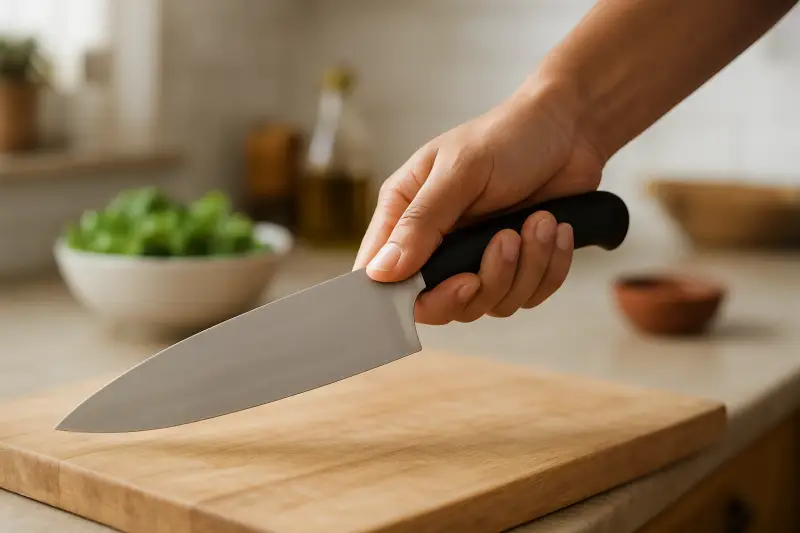
Handle fit and balance
Balance and grip comfort matter more for everyday use than almost any other spec, and they're genuinely hard to judge from a photo or spec sheet alone. If you can, hold a knife in a store before buying online, or check the listed weight and handle dimensions against a knife you already know feels comfortable.
A knife that feels front-heavy (weighted toward the blade) can feel more effortless for chopping through denser vegetables, while a more balanced or handle-heavy knife can feel more controllable for detail work. Neither is objectively better -- it's a matter of what suits your hand and your typical prep tasks.
Full-tang construction, where the blade's steel extends the full length of the handle, is generally considered more durable than partial-tang designs, and it's a reasonable detail to check on a listing's description or images before buying.
Browse our recommended picks
Our featured picks refresh periodically. While we update them, our editorial guides can help you find the right one.
See our guidesOur selection criteria
When we point to a specific category of chef's knife on this site, we're evaluating listings against these disclosed criteria: blade length appropriate for general home use (commonly 8 inches), stainless steel construction for low-maintenance care, disclosed handle material and full-tang construction where stated, and a design suited to everyday chopping rather than a specialty cutting task.
We do not claim to have personally tested or sharpened the specific knives linked from this site, and we don't publish star ratings or review counts. Our recommendations reflect desk research against the criteria above, applied consistently.
Knife sets vs. a single knife
Multi-piece knife sets, often sold in a block with eight to fifteen pieces, can look like better value at a glance since they cover more tasks for a similar or only slightly higher price than a single quality chef's knife. In practice, most home cooks reach for the same one or two knives repeatedly -- usually the chef's knife and maybe a paring knife -- while several other pieces in the block go untouched for months or years.
Because manufacturing budget is spread across many pieces in a set, the individual knives are sometimes lower quality than a single dedicated chef's knife sold on its own at a similar price point. If you're specifically prioritizing one excellent everyday knife over a full collection, a standalone chef's knife purchase often gets you better construction for the same money than one piece pulled from a large set.
That said, sets aren't inherently a bad choice, especially if you know you'll use several different blade types regularly -- a bread knife for crusty loaves, a paring knife for detail work, and a utility knife for mid-size tasks all have genuine uses. The key is being honest about which pieces you'll actually reach for, rather than assuming more knives automatically means better value.
A reasonable middle path for many beginners: start with a single well-chosen chef's knife, use it exclusively for a few weeks, and then decide whether a second or third knife would fill a genuine gap in your routine, rather than buying a full block upfront on the assumption you'll need everything in it.
Care and sharpening
Hand-wash and dry your knife immediately after use rather than leaving it in a sink or running it through the dishwasher, which can dull the edge and damage the handle over repeated cycles. Store it in a knife block, on a magnetic strip, or in a blade guard rather than loose in a drawer, both for blade longevity and for safety.
A budget knife benefits even more from regular honing (realigning the edge with a honing rod) between full sharpenings, since it helps the edge stay usable longer between trips to a sharpening service or a home sharpening stone. How often to sharpen depends on frequency of use; if cuts start requiring noticeably more pressure, that's a practical sign it's time.
Always cut on a stable cutting board, keep fingers curled away from the blade edge when guiding food, and never leave a knife submerged out of sight in a sink of soapy water, where it becomes a hidden hazard.
If a board tends to slide on the counter, a damp towel or a rubber grip mat placed underneath it adds meaningful stability, especially for anyone still building confidence with knife technique. A stable board matters as much for safety as any feature of the knife itself.
Final thoughts
A well-chosen affordable chef's knife covers the overwhelming majority of everyday home cooking tasks, and the selection criteria above -- blade length, material, handle fit, and construction -- matter more than brand name or price alone. Evaluate any specific listing against this framework rather than assuming a higher price automatically means a better fit for your hand.
See our kitchen utensils hub for the rest of an everyday utensil lineup, and our beginner kitchen essentials checklist for what to prioritize alongside a first knife.