Why the Right Sharpener Matters
If you are trying to figure out how to choose a knife sharpener, start with the job you want it to do. A good sharpener should help keep everyday kitchen knives working well without making the process complicated. For most home cooks, the goal is not a perfect edge for showpieces. It is a practical edge that makes slicing, chopping, and trimming feel easier and more controlled.
The right tool also depends on how often you cook and what kinds of knives you own. A family kitchen may need something simple for routine upkeep, while a more active home cook may want a sharper edge with a little more consistency. The best choice is usually the one that matches your knives, your comfort level, and the amount of effort you want to put into maintenance.
It helps to think of a sharpener as part of a longer routine, not a one-time fix. Knives stay useful longer when they are maintained regularly. That means choosing a sharpener you will actually use matters just as much as choosing one with the right features on paper.
Understand the Main Types
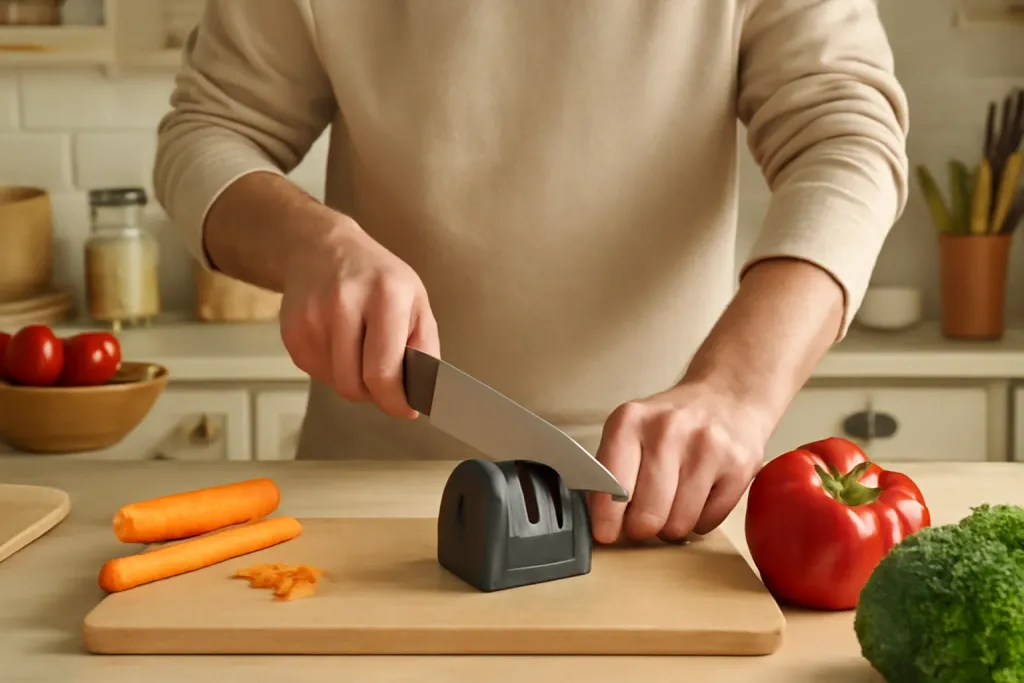
When learning how to choose a knife sharpener, the first big decision is the type. Home sharpeners generally fall into a few common groups, and each has tradeoffs. Pull-through sharpeners are often the easiest to use because the angle is set for you. They are usually aimed at convenience, which makes them appealing for busy kitchens. The tradeoff is that they may offer less control than other options.
Manual whetstones, sometimes called sharpening stones, give more control and can be a good fit for people who want to learn a traditional method. They typically require more patience and a steadier hand, but they can work well if you are willing to practice. Guided-angle systems sit somewhere in the middle. They help maintain a consistent angle while still giving more involvement than a basic pull-through model.
Electric sharpeners can be attractive for households that want speed and less effort. They may be especially appealing if several knives need regular upkeep. That said, they still vary in complexity, and some are better suited to certain blade types than others. The main point is to choose the style that fits your routine, not just the one that sounds most advanced.
Match the Sharpener to Your Knives
Not every sharpener works equally well for every blade. If you are deciding how to choose a knife sharpener, look closely at the knives you already own. Common kitchen knives such as chef's knives, paring knives, and utility knives are usually the easiest place to start. If those are the blades you use most, a sharpener that handles standard straight-edge kitchen knives may be enough.
Some knives need more careful handling. Serrated blades, fine Japanese-style knives, and thicker German-style knives can have different sharpening needs. A sharpener that is friendly to one blade style may be less suitable for another. This is one reason it is important to check whether a sharpener is designed for straight edges only or whether it can also handle specialty blades.
Think as well about blade material and condition. A very dull knife may benefit from a different approach than one that simply needs regular touch-ups. If your household uses a mix of inexpensive utility knives and better chef's knives, you may want a sharpener that balances ease with enough flexibility to serve more than one purpose.
Focus on Angle Control and Guidance
One of the most important features to consider is how the sharpener handles angle control. The angle is the relationship between the blade and the sharpening surface, and consistency matters. A tool that helps you keep the angle steady can make sharpening simpler and more predictable, especially if you are not confident doing it freehand.
For many home cooks, guided systems are appealing because they reduce guesswork. Pull-through models often provide a fixed angle, while some manual systems use slots or guides to help you keep the blade aligned. Whetstones can offer more flexibility, but that flexibility comes with more responsibility. If you are still learning, guidance can make the experience less frustrating.
It is worth remembering that more control is not always better if it makes the process too difficult for your household. A sharpener that is technically versatile but awkward to use may end up sitting in a drawer. When comparing options, ask whether the angle system feels intuitive and whether it matches the skill level of the person most likely to use it.
Browse our recommended picks
Our featured picks refresh periodically. While we update them, our editorial guides can help you find the right one.
See our guidesCheck Safety and Ease of Use
Home sharpeners should be practical, but they should also be comfortable to use. Safety features and simple handling can make a real difference, especially in busy kitchens. Look for a base that stays steady on the counter, a shape that gives you a secure grip, and a design that keeps your hands away from the blade path as much as possible.
Ease of use matters for another reason: it affects how often the sharpener gets used. If the process feels awkward or confusing, people tend to postpone it until the knives are already in poor shape. A straightforward setup can encourage regular upkeep and make kitchen tasks less tiring overall.
Also think about the number of steps required. Some sharpeners ask for careful setup or multiple passes through different stages, while others are more direct. Neither is automatically better. The right choice depends on how much attention you want to give the process and whether you are comfortable following a more detailed routine.
Consider Maintenance and Durability
A sharpener is only helpful if it stays in good working order. That is why maintenance is an important part of how to choose a knife sharpener. Some tools need little more than an occasional wipe-down, while others may require cleaning after use or periodic replacement of parts. Before buying, consider how much upkeep you are willing to handle.
Durability also matters in a home setting. A sharpener that feels flimsy may not hold up well if several family members use it over time. Materials, construction, and overall stability can influence how long the tool remains useful. You do not need to chase the most complicated design to get something dependable, but it is sensible to look for a product that seems built for regular kitchen use.
If you want the sharpener to be part of a long-term kitchen routine, think about how easy it will be to store as well. A compact tool may be more likely to stay accessible, which makes upkeep easier. The best choice is often the one that is simple enough to keep on hand and sturdy enough to trust repeatedly.
Compare Convenience vs. Control
One of the clearest tradeoffs in choosing a sharpener is convenience versus control. A more convenient sharpener can save time and reduce the learning curve. A more controlled sharpening method can offer finer adjustment and greater involvement. The best option depends on what your kitchen values most.
If several people in the household will use the sharpener, convenience may be the deciding factor. A tool that is simple and repeatable can be easier to share. If you are the main cook and you enjoy a more hands-on approach, a system that gives you more control might be worth the extra effort.
There is no single best answer for every home. What matters is the match between the tool and the routine. A sharpener that makes you more likely to maintain your knives is usually a better buy than one with impressive features that you will rarely use. That is especially true in family kitchens, where time and attention are often limited.
A Simple Buying Checklist
Before you decide how to choose a knife sharpener for home use, run through a short checklist. First, confirm the sharpener is appropriate for the knives you own. Second, decide whether you want the simplest possible option or one that gives you more control. Third, think about how often you will sharpen and who will be using the tool.
Next, consider the setup. Is it easy to store, easy to clean, and steady enough to feel comfortable on the counter? Does it seem suitable for regular kitchen upkeep rather than a one-time project? If the answer is yes, the sharpener is more likely to fit into normal household life.
Finally, choose the option that you can use consistently. A sharpener does not need to be complicated to be effective in a home kitchen. It just needs to suit your knives, your pace, and your comfort level. That practical fit is the most useful guide for most shoppers.