

Quick answer
The clock starts the day the chicken is cooked, not the day you opened the container. Roast a chicken on Sunday and Thursday is the last day the USDA's 3 to 4 day window covers. That window is for cooked chicken kept cold the whole time, so it assumes the bird went into the fridge promptly, which the 2-hour rule below explains.
If you want a lookup for other foods, the food storage times tool searches the same USDA chart.
Chicken fridge and freezer times
The chart separates raw from cooked, and treats chicken dishes the way it treats other leftovers. The rows below come straight from the USDA Cold Food Storage Chart. Fridge times assume 40 °F or below. USDA writes the freezer figures as quality guidance: food kept continuously at 0 °F (-18 °C) or below stays safe indefinitely, but it can dry out or lose flavour the longer it sits.
| Chicken or chicken dish | Fridge (40 °F or below) | Freezer (0 °F or below) |
|---|---|---|
| Chicken or turkey, whole, raw | 1 to 2 days | 1 year |
| Chicken or turkey, pieces, raw | 1 to 2 days | 9 months |
| Ground chicken, turkey or other poultry, raw | 1 to 2 days | 3 to 4 months |
| Cooked chicken or other poultry (leftovers) | 3 to 4 days | 2 to 6 months |
| Chicken nuggets or patties, cooked | 3 to 4 days | 1 to 3 months |
| Sausage, raw, from chicken or turkey | 1 to 2 days | 1 to 2 months |
| Sausage, fully cooked, from chicken or turkey | 1 week | 1 to 2 months |
| Egg, chicken, ham, tuna and macaroni salads | 3 to 4 days | Does not freeze well |
| Soups and stews with vegetables or meat | 3 to 4 days | 2 to 3 months |
Two things in the table surprise people. Raw chicken has the shortest fridge life of anything here, 1 to 2 days, so a pack bought on Saturday should be cooked or frozen by Monday. And cooked chicken goes into the same 3 to 4 day window as any other cooked leftover, whether it was breast, thighs, a whole bird or part of a casserole.
The 2-hour rule
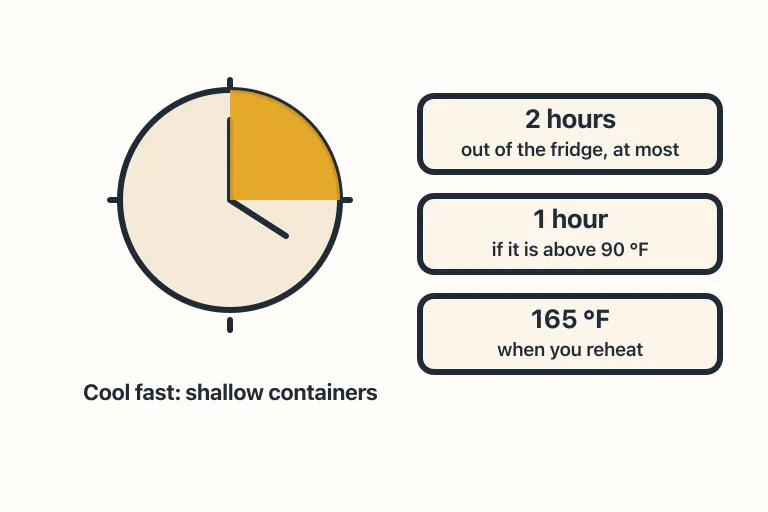
The USDA Food Safety and Inspection Service says leftovers must be refrigerated within 2 hours of cooking, or of coming out of a warming appliance. If the room is above 90 °F, as at a summer picnic, the limit drops to 1 hour. Perishable food left out longer than that should be thrown away, however good it looks. Bacteria grow quickly between 40 °F and 140 °F, and hot food should be held at 140 °F or warmer until it is served.
Chicken is often served in pieces, which makes it easy to forget on the counter. A practical habit is to carve what you will eat, then put the rest away before you sit down. A rotisserie chicken that came home hot in a bag and sat through a long dinner is a common case: the 2 hours include the time it sat in the car.
Storing it so it lasts
The 3 to 4 days is a ceiling, not a target, and the way you store the chicken decides whether it reaches it. USDA advises cooling food quickly by dividing large amounts into shallow containers, so a big pot or a whole carcass is not still warm in the middle hours later. Pull the meat off the bone, put it in one or two shallow, lidded containers, and cover it so it does not dry out.
Put the container on a shelf, not the door, where the temperature swings every time the fridge opens. A fridge thermometer is the way to know the real temperature; the USDA's numbers all assume 40 °F or below. Write the cooking date on the lid with masking tape or a dry-erase marker, so nobody has to guess.
Keep cooked chicken away from raw meat. Store raw poultry on the lowest shelf, in a container that catches drips. Our guides to glass versus plastic food storage containers and cutting food waste with better storage cover the containers.
More gear for this
Search links on Amazon.com. We earn from qualifying purchases.
Freezing cooked chicken
If you will not eat it within 3 to 4 days, freeze it on day one or two rather than on day four. The USDA chart gives 2 to 6 months for cooked meat and poultry, 1 to 3 months for chicken nuggets and patties, and 2 to 3 months for soups and stews. Chicken salad does not freeze well.
Freeze in portions you will use at one time, such as two breasts or one dinner's worth of shredded meat, so you never thaw more than you need. Label each bag with the contents and the date. Frozen chicken that has thawed in the fridge keeps the same 3 to 4 day window as other leftovers, so plan the meal before you take it out.
Freezer wrap matters for quality. Press the air out of a freezer bag, or use a container with little empty space, and flatten bags so they freeze and thaw quickly. USDA's safe thawing methods are the refrigerator, cold water and the microwave. Food thawed in the fridge is safe to use for another 3 to 4 days or to refreeze. Microwave-thawed food should be heated until it reaches 165 °F, after which it can be refrozen.
Reheating to 165 °F
USDA says to reheat leftovers to 165 °F as measured with a food thermometer. Put the probe in the thickest part, away from bone. Cover the dish while reheating, which keeps moisture in and helps the food heat all the way through. Sauces, soups and gravies should be brought to a rolling boil.
| What | Target |
|---|---|
| Cooked chicken and other leftovers, reheated | 165 °F (74 °C) |
| Raw chicken cooked from scratch, all cuts and ground | 165 °F (74 °C) |
| Gravy, soup and sauce with chicken | Rolling boil |
An air fryer reheats chicken well and gets the skin crisp again; University of Illinois Extension suggests setting it to 350 °F and cooking until the food reaches 165 °F. Our oven to air fryer calculator covers converting a recipe for the same appliance. An instant-read thermometer is the only way to be sure of 165 °F, so it is worth keeping next to the fridge.
Why looks and smell are not enough
Chicken can carry bacteria that cause food poisoning without looking or smelling off. That is why the USDA gives times rather than telling you to judge by smell, and why we do not suggest a sniff test. If the chicken is past 3 to 4 days, or you cannot remember when it was cooked, throw it out.
The same goes for chicken that has been out of the fridge too long. The cost of discarding a few pieces is small next to the cost of a bad night. When in doubt, throw it out.