Start With a Clean Slate
Before you organize under sink kitchen storage, empty the cabinet completely and look at the space without the clutter. This area often collects dish soap, sponges, sprays, trash bags, refills, and odds and ends that do not belong anywhere else. Taking everything out makes it easier to see what you actually use and what is only taking up room.
Sort the contents into a few basic groups: cleaning products, dishwashing supplies, trash and recycling items, reusable tools, and anything that should be stored somewhere else. Set aside empty bottles, duplicates, and containers that are leaking, broken, or too large for the cabinet. If you find items that are rarely used, move them to a more suitable place in the kitchen or pantry.
Once the cabinet is empty, wipe down the base, sides, and door area. Look for pipes, shutoff valves, disposal cords, or a water filter, since these features shape what can fit. A quick measurement of width, height, and depth can save time later and help you avoid organizers that block access or waste space. This is also a good moment to think about how your household actually uses the cabinet. Daily-cooking families may need fast access to soap and scrub tools, while smaller households may only need a compact spot for backups.
Choose a Simple Layout That Matches the Space
The easiest way to organize under sink kitchen storage is to give each category a clear zone. A cabinet that tries to hold everything in one large pile usually becomes messy again quickly. Instead, think in terms of left, right, center, front, and back zones, depending on the shape of the plumbing and the size of the cabinet.
Many kitchens work well with a simple three-part setup. One side can hold cleaning sprays and wipes, another can hold dishwashing supplies, and the remaining space can stay open for plumbing clearance or bulk items. If the drain or disposal sits off-center, use the open space around it rather than forcing in a shelf or bin that fights the cabinet shape.
Frequently used items should live where they are easiest to reach, often at the front or in a removable caddy. Less-used backups can go farther back or on a higher level if the cabinet has room. A straightforward layout is usually better than a complex one with too many small containers. The goal is to make the cabinet easy for everyone in the household to use, not just neat for one day.
Use Containers That Fit Around Pipes and Fixtures
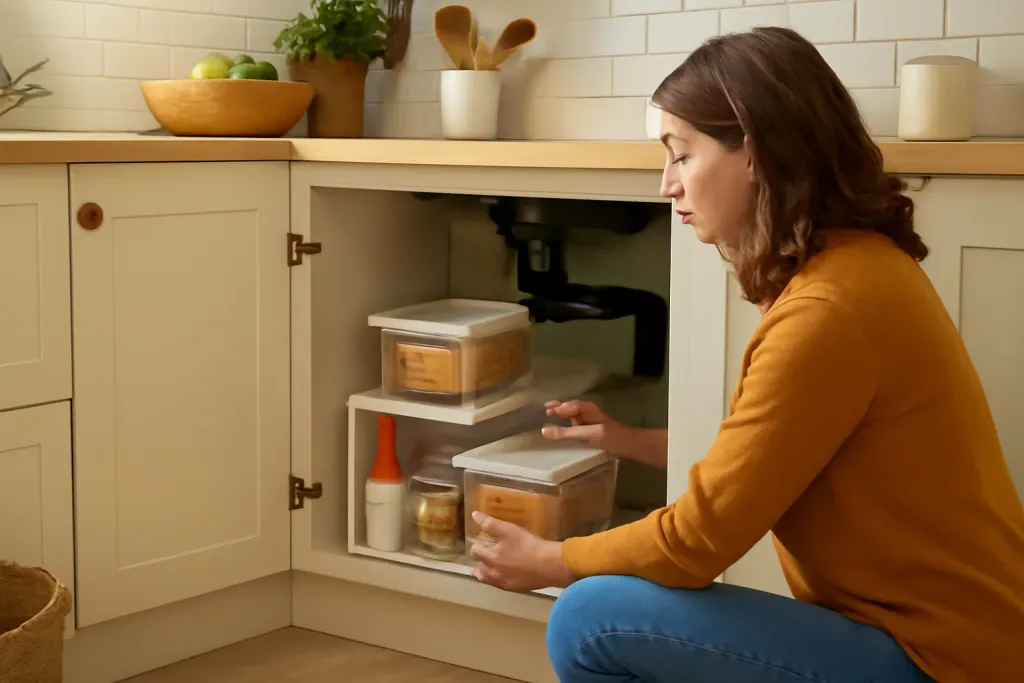
Under-sink cabinets are rarely a perfect rectangle, which is why standard storage boxes often fall short. Slim bins, adjustable caddies, and stackable trays are often more useful than large square containers that block access or leave awkward gaps. The best fit is one that works around pipes, valves, and disposal units instead of ignoring them.
Tiered shelves can help when there is enough height, but they should still allow you to reach items without moving half the cabinet. Pull-out drawers or slide trays can be useful in deeper cabinets because they bring supplies forward and reduce digging. Just make sure any organizer leaves enough room for the plumbing and door clearance. Measuring before buying is one of the simplest ways to avoid clutter and returns.
Clear containers can make it easier to spot refills at a glance, while opaque bins can create a cleaner uniform look. Either can work. What matters most is that the organizer fits the cabinet shape and makes daily use easier. A system that respects the real layout of the space will usually stay useful longer than one chosen only for appearance.
Separate Daily Use From Backups
A smart under-sink setup usually works best when it separates daily-use items from backups. Daily-use items are the things you reach for often, such as dish soap, a sponge, a scrub brush, or a small cleaning spray. Backups are the extras you replace less often, like unopened refills, extra trash bags, and spare cleaning cloths.
Keeping these groups apart makes the cabinet easier to navigate and reduces the chance of overbuying. Daily-use items should stay in the most convenient spot, ideally in a front-facing bin or removable caddy. Backups can live behind them, in a labeled bin, or on a shelf if the cabinet height allows it. That way, you can see what you already have before adding more.
If several people use the kitchen, group items by task so the system stays intuitive. Dishwashing tools can stay together, surface cleaners can stay together, and waste-sorting supplies can stay together. The less complicated the rules, the more likely the cabinet will stay orderly when the kitchen is busy and nobody has time for a full reset.
Browse our recommended picks
Our featured picks refresh periodically. While we update them, our editorial guides can help you find the right one.
See our guidesMake Room for Trash and Recycling Supplies
Many households use the cabinet for trash bags, compost liners, or recycling accessories, and those items can fit well if they are contained neatly. The key is to keep them from spreading into every open corner. A narrow bin, flat box, or hanging organizer can hold these supplies without making them hard to find.
If you store trash bags under the sink, keep them in a container that lets you grab one quickly. If you keep compost or recycling items there too, separate them so they do not get mixed in with cleaning products. That saves time when you are cooking and cleaning at the same time. It also helps the cabinet stay clearer and easier to maintain.
Some people like to use the cabinet door for a small organizer, but that only works well if it does not interfere with plumbing access or put too much weight on the door. In smaller cabinets, it may be better to keep a smaller reserve of waste supplies rather than trying to store too much. A compact, easy-to-reach supply is often more practical than a crowded cabinet full of extras.
Keep Safety and Access in Mind
Because this storage area sits near plumbing, it should remain easy to inspect and simple to reset. Leave enough room to reach shutoff valves, pipes, and other fixtures without moving a stack of bins. If a small leak ever appears, a cluttered cabinet can make it harder to notice and harder to clean up.
Avoid placing items that could be damaged by moisture directly on a damp cabinet floor. Raised trays or elevated bins can help keep supplies off the bottom when needed. It is also wise to check the cabinet now and then for drips, residue, or signs that something has shifted. Keeping the layout flexible makes it easier to remove items if access to the plumbing is needed.
Heavier items should sit lower and closer to the front so they are easier to lift. Lighter items can go higher or farther back. This makes the cabinet safer to use and helps stop containers from tipping when the door opens and closes. Think about hinge placement, door swing, and the space needed to reach in comfortably. A system that blocks normal access will not stay useful for long.
Maintain the System With Small Habits
Once you organize under sink kitchen storage, the real work is keeping it that way. Small habits make a big difference: put items back where they belong, toss empty containers promptly, and do a quick review every few weeks. That is usually enough to catch clutter before it spreads.
A reset does not need to be complicated. Remove anything that does not belong, wipe up drips, and check whether the layout still fits the way your household cooks and cleans. If a product is used more often than before, move it closer to the front. If an item is no longer needed, relocate it or let it go. Good organization should adapt to the kitchen, not force the kitchen to adapt to the storage.
Labels can help, but simple labels are best. A bin marked for trash bags or dishwasher supplies can make it easier for everyone to return items correctly. Some families also use color-coding, but the best system is the one your household can realistically keep up with. If the cabinet starts to feel crowded again, reassess the items first before adding more organizers. Often the issue is not a lack of storage products, but too many supplies for the space.
Pick the Right Organizer Types for Your Household
Different kitchens need different solutions, so the right organizer is the one that matches how your household uses the cabinet. A single caddy may be enough in a smaller home with limited supplies. A larger family may prefer a mix of a pull-out tray, a narrow bin, and a small shelf to separate categories without crowding the space.
If you want flexibility, choose modular pieces that can be rearranged as your needs change. That can be useful if you switch cleaning products, add a water filter, or decide to store different supplies under the sink. Modular storage also makes sense in kitchens that may change over time. Look for organizers that are easy to clean and simple to remove, since this area naturally deals with dust, drips, and the occasional spill.
The most dependable under-sink setup balances fit, access, and simplicity. You do not need a complicated makeover to make the cabinet useful. A few well-chosen containers, a clear layout, and a regular reset routine can turn a cluttered space into a dependable part of the kitchen.